

A Traditional IRA can be a useful way to save for retirement and potentially reduce current-year taxable income, but the direct answer to “are traditional IRA contributions tax deductible” is: sometimes. Deductible contributions generally depend on whether you have earned income, whether you’re covered by a work retirement plan or other retirement accounts, and whether your income falls within IRS rules and traditional IRA contribution limits, so the full amount may be allowed, limited, or not deductible at all.
For people planning for retirement and trying to decide between a traditional or Roth IRA—or simply confirm whether they’re eligible to make and claim deductible contributions—these rules are important because they affect both your tax bill now and your long-term saving strategy. We’ll discuss who is eligible to make contributions, how employer-plan coverage changes deductibility, when Roth rules differ, and what to remember before opening or funding an IRA so your tax and retirement planning work together.
Earned Income Eligibility
To contribute to a Traditional IRA, you must have earned income. That means employees, including full time employees, as well as self-employed workers can qualify to contribute if they have eligible compensation. When allowed, deductible contributions can reduce taxable income dollar for dollar and be claimed on your federal return. Passive income such as investment earnings or rental income does not qualify as earned income for IRA contribution purposes.
What Makes A Traditional IRA Contribution Tax-Deductible?
A Traditional IRA contribution may be deductible if you are not covered by a workplace plan or if you are covered by a retirement plan at work but meet certain Modified Adjustment Gross Income (“MAGI”) thresholds determined by the IRS. In addition, any contribution to a traditional or roth ira can affect the full amount allowed because the traditional IRA contribution limits apply on a combined basis under IRS rules. Traditional IRAs generally let you reduce taxable income now, but you may later pay income taxes on withdrawals, while Roth accounts can offer tax free growth and tax free withdrawals if requirements are met.
Influence of Roth IRA Contributions
While contributing to a Roth IRA does not prevent you from contributing to a Traditional IRA, the deductibility of a traditional or roth ira contribution depends on how the IRS applies the combined annual cap and whether you can claim the deduction.
The total annual contribution limits across Traditional and Roth IRAs are: 2026 tax year: The lesser of your earned income or $7,500 ($8,600 if you’re age 50+).
Employer-Sponsored Plan Coverage
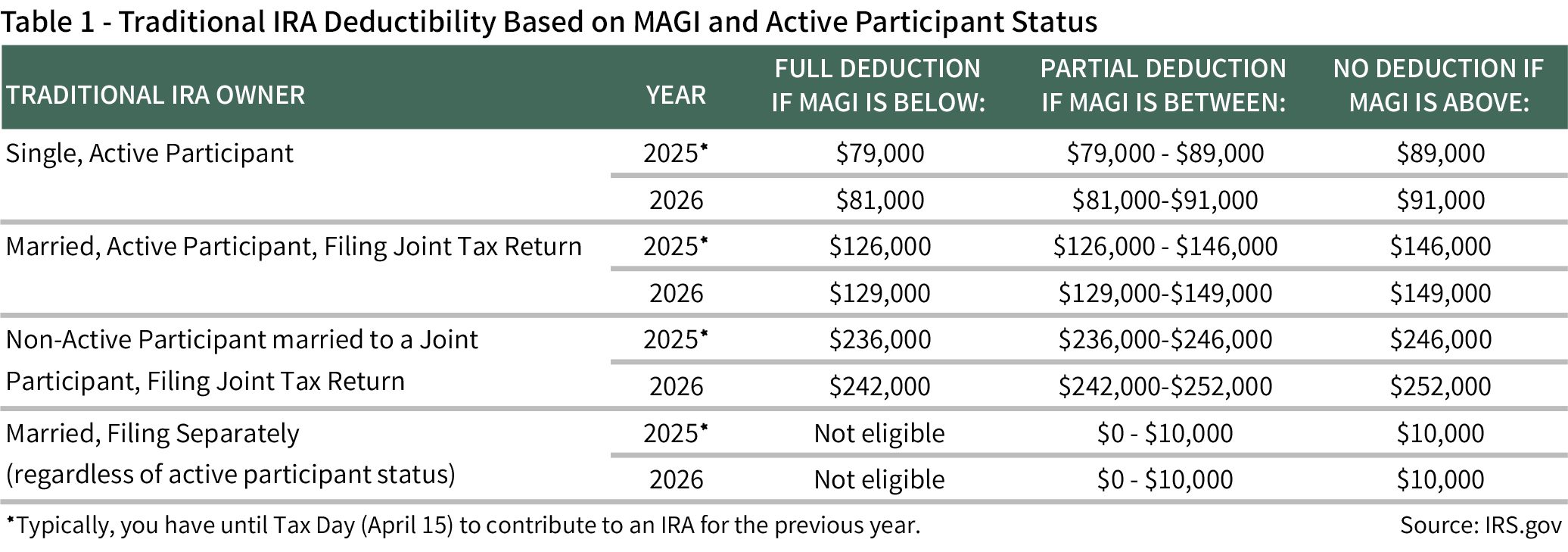
Another factor affecting Traditional IRA deductibility is whether you or your spouse are covered by a workplace retirement plan at work, such as a 401(k) or 403(b), since being covered by a workplace plan can make deductible contributions limited based on filing status and MAGI level. Active participation in such a plan may affect whether your contribution is fully deductible, partially deductible, or not deductible at all. If not, you may still make a nondeductible IRA contribution. Understanding traditional IRA contribution limits can help you avoid excess contributions and possible tax penalties. The thresholds for deductions are as follows in Table 1. Additional information can be found on the IRS website.
Wondering why you’re handling this on your own?
Deciding which retirement accounts meet your needs can be complex and time-consuming. As a client of Godsey & Gibb Wealth Management, you can partner not only with a wealth advisor with deep retirement planning expertise, but also with our in-house CPA team who can help structure your portfolio for optimal tax efficiency.
If you’re interested in learning more about working with us, reach out by clicking the “Meet With An Advisor” button below!
Written: March 6, 2026